
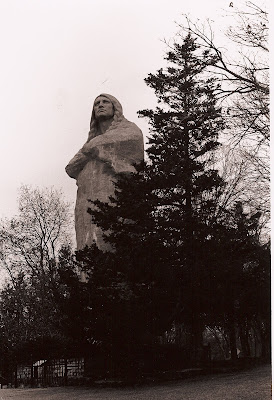
The Black Hawk Memorial stands nearly 50 feet tall and rises on a 77-foot bluff above the Rock River. It pays homage to the Chief of the Fox and Sauk tribes who fought against the United States in the War of 1812. Lorado Taft designed the statue in 1908, long after the memory of this chief — who had controlled the region of the Mississippi and Rock Rivers until the 1830s — had vanished.
Chief Black Hawk moved to Iowa in the early 1830s. But his monument stands in Oregon, IL, site of an art colony co-founded by Lorado Taft.
Taft sheathed him in a blanket and simplified his form to focus on the face. The main ingredient is concrete, an interesting contrast to the wild environment. (It also differs from the more radiant granite and bronze of his tomb memorials.) Taft and his student John Prasuhn modeled the statue using a hollow core and iron tie rods. They created a broad sweeping column for the body leading up to the sad, heroic face.
Black Hawk died in 1838. Native American culture didn’t seem to continue in the area, a fact not lost on Taft when he chose a generalized face. It is not a likeness at all. He considered this statue the Eterna l Indian, on a monumental scale. Depending on one’s view, it could symbolize grief, greatness, a visionary leader, or heroic pride. The artist searches for depth of meaning, rather than complete sadness.
Relationship to other works by Taft
 12 other founding families to move to Chicago from Ohio. The artist must have known this irony when he was creating the statues. The memory of Black Hawk looms much larger and more specific than the memory of Graves; he commands a part of the environment.
Excellent, Julie. You did a great job in unveiling the tragic history behind this work.
Thomas
The statue urgently needs repair. Due to a very harsh winter, its condition is worse than described in this article from last year:
http://www.rrstar.com/article/20130126/News/301269927