by admin | Mar 6, 2010 | Augustus Saint-Gaudens, Lorado Taft
Tomb memorials can be magnets for travelers to major cities. The Adams Memorial in Rock Creek Cemetery was a major tourist attraction in the capital city long before the memorials came to the National Mall in Washington, DC. Hearing of its fame, I decided to visit it. I compared this monument to a tomb by Lorado Taft in Chicago, because I have always been moved by Taft’s Solitude of the Soul at the Art Institute of Chicago.
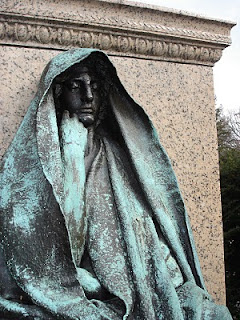
The Adams Memorial is a seated bronze figure with an androgynous face and deep, textured drapery. Augustus Saint-Gaudens completed it in 1891. Its green patina and mottled effect beautifully contrast with the speckled pink granite base and block designed by architect Sanford White. By comparison, Lorado Taft’s sculpture, erected in 1909, is starker; it takes the memorial concept further into 20th century abstraction.
Henry Adams, a 19th century historian and novelist, commissioned the Adams Memorial after his wife, Clover Hooper Adams, died by suicide in 1885. An amateur photographer of some note, Clover had suffered from depression before swallowing potassium cyanide, a chemical used in developing her photographs. Saint-Gaudens planned and executed the sculpture over 5 years. He claimed to base the statue on iconic Buddhist statues and the grandeur of Michelangelo, particularly his Sibyls on the Sistine Ceiling He strove to capture an eternal presence in a figure that will never be alive to Adams, or us, again.
Impressions of Saint-Gaudens statue
Saint-Gaudens entitled this work the The Mystery of the Hereafter and the Peace of God that Passeth Understanding, but the public called it “Grief,” a term Henry Adams never accepted. Adams, a grandson and great-grandson of US Presidents, was buried here when he died in 1918.
Henry Adams’ needed to come to terms with his wife’s death, of which he avoided speaking or writing. Yet the loss deeply affected him. Whether there was guilt, regret or other unresolved feelings, he seems to have used the monument to make peace with those feelings.
 The statue expresses neither joy nor anguish, but acceptance. The memorial avoids ideas about judgment and the hereafter, but evokes concepts of the divine feminine. Adams visited this grave statue often, but never met the state of peace the image portrays. (Yet the powerful female spirit appears to have influenced him long afterwards, as revealed in his books, The Education of Henry Adams and Mont Saint-Michel and Chartres.)
The bronze figure, its face and strong hands are powerfully reminiscent of Michelangelo. The drapery is very heavy, but the woman’s face is not covered. She raises an arm and hand to intercept the veil, emphasizing that face. The eyes appear closed at first glance, but they’re open, looking downward. An earthly existence is vanishing but still present. She is present to us in a timeless way, since the Saint-Gaudens’ statue tries to avoid the finality of loss so pervasive in the statues of Lorado Taft.
Eternal Silence
 Eternal Silence
 is the appropriate name Lorado Taft gave the grave marker of Dexter Graves in Graceland Cemetery, Chicago. A heavily draped bronze figure pulls his robe over his mouth, snuffing out his presence in the world. A hand covers the mouth, unlike Adams’ figure whose hand opens the veil like a curtain to reveal a face. Here the individual portrait is completely irrelevant; he is representative of an eternal truth, the finality of a life. Eyes are closed and, like most of the face, they are blackened.
Taft prefers broad, bold simplified shapes in sculpture, as opposed to the Adams Memorial’s more nuanced drapery folds. The bronze’s patina is a light green, in contrast to the black face. A nose pops out under the hood–also green. It’s spooky. No wonder many tales about ghosts have come from those who have visited the statue. For the record, Dexter Graves died in 1844. He came to Chicago from Ohio with 12 other founding families of the city in 1831. He built a hotel in Chicago and his son Henry commissioned the monument in 1907.The statue and sky reflect behind into black granite, the
 same material used in the Vietnam Veterans’ Memorial. Taft simplified the outer garment, barely suggesting a large masculine physique underneath. The figure stands erect, his silencing complete.
Taft — like Michelangelo and Rodin — was committed to using the human figure to express the greatest truths as he saw it, even if his ideas were abstract.
by Julie Schauer | Feb 10, 2010 | Lorado Taft, Memorials, Sculpture
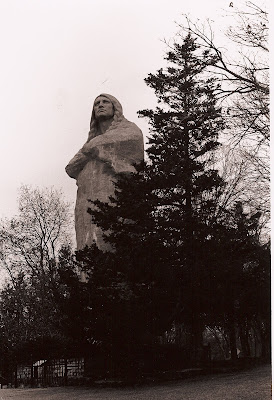
The Black Hawk Memorial stands nearly 50 feet tall and rises on a 77-foot bluff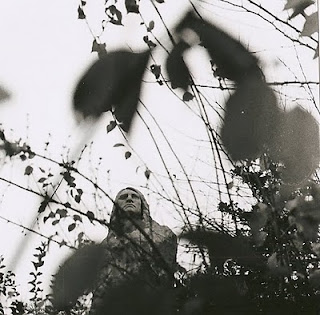 above the Rock River. It pays homage to the Chief of the Fox and Sauk tribes who fought against the United States in the War of 1812. Lorado Taft designed the statue in 1908, long after the memory of this chief — who had controlled the region of the Mississippi and Rock Rivers until the 1830s — had vanished.
Chief Black Hawk moved to Iowa in the early 1830s. But his monument stands in Oregon, IL, site of an art colony co-founded by Lorado Taft.
Taft sheathed him in a blanket and simplified his form to focus on the face. The main ingredient is concrete, an interesting contrast to the wild environment. (It also differs from the more radiant granite and bronze of his tomb memorials.) Taft and his student John Prasuhn modeled the statue using a hollow core and iron tie rods. They created a broad sweeping column for the body leading up to the sad, heroic face.
Black Hawk died in 1838. Native American culture didn’t seem to continue in the area, a fact not lost on Taft when he chose a generalized face. It is not a likeness at all. He considered this statue the Eterna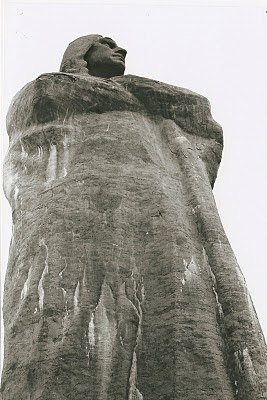 l Indian, on a monumental scale. Depending on one’s view, it could symbolize grief, greatness, a visionary leader, or heroic pride. The artist searches for depth of meaning, rather than complete sadness.
Relationship to other works by Taft
Simultaneously, Taft was working on Eternal Silence, a commission for Dexter Graves’ tomb 100 miles away in Chicago. Black Hawk was Lorado Taft’s own inspiration on the site owned by Eagles’ Nest Art colony he had founded in 1898. When his funds ran short, the state of Illinois paid for the statue’s completion in 1911. Chief Black Hawk’s move made it possible for Dexter Graves and
 12 other founding families to move to Chicago from Ohio. The artist must have known this irony when he was creating the statues. The memory of Black Hawk looms much larger and more specific than the memory of Graves; he commands a part of the environment.
Lorado Taft possessed a grand vision–equal to Black Hawk’s, for his students and art, but his reputation as a sculptor waned. An influential writer and teacher at the Art Institute, he made a large Fountain of Time near the University of Chicago. He also made Alma Mater and The Blind at the University of Illinois in Urbana. The Columbus Monument at the Union Station in Washington, DC is one of his national commissions. An online group follows his work.
Copyright Julie Schauer 2010-2026




Recent Comments