by Julie Schauer | May 14, 2017 | An Object of Beauty, DeKooning, Sotheby's, Steve Martin, Warhol
 |
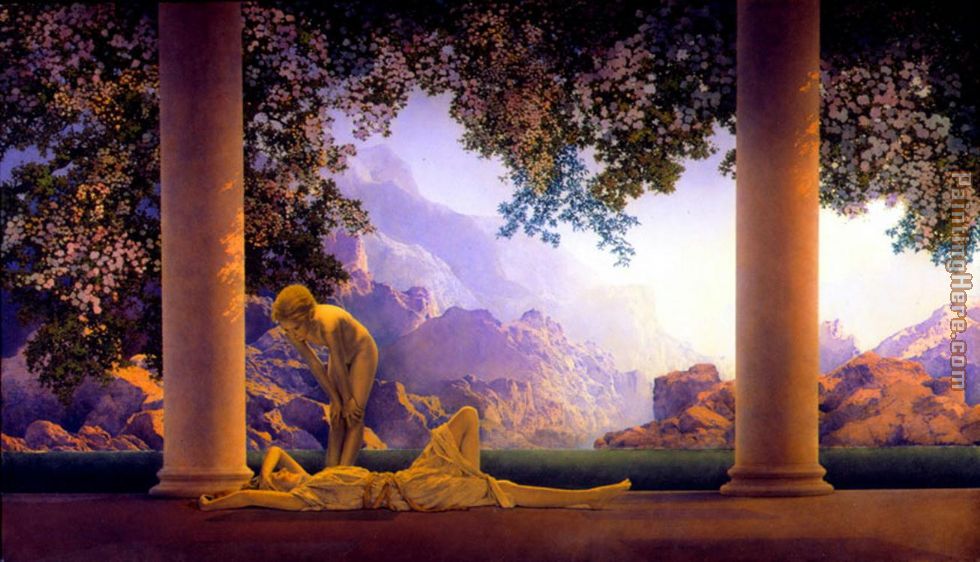
| Maxfield Parrish, Daybreak, 1922 |
An Object of Beauty, is a surprising novel by a man of many talents, Steve Martin. Last year, in the Spring, I had seen a musical by him in New York and was then surprised to get this book as a Mother’s Day present. Not only is it an original novel, but it shows that Steve Martin is a gifted interpreter of both art and the art world. The novel exposes the mystique and glamor of the art world, together with its sleaze.
 To be honest, valuing art primarily for its monetary or investment value really offends me. I briefly worked in the 80s at the art gallery considered one of Chicago’s leading contemporary galleries at the time. It was surprising to go from a show of DeKooning’s latest works (painted with mayonnaise) to one of photographs of Racquel Welch (by an important photographer). Although these exhibitions generated a ton of publicity, they actually sold very little — just one DeKooning and none of the Racquel Welch photographs. (sh….that was an art world secret.)
Martin understands that the glitter of the art world which is hiding beyond a multitude of facades. The narrator is an art critic with a curiosity about, or a crush, on a fellow art history major he knew from college. Her name is Lacey. The story winds through the years, beginning with the author’s idealization of Lacey through various stages of recognizing and figuring out what makes her tick. Lacey lands a minor, low-paying working for Sotheby’s in New York and ends up owning a gallery in edgy Chelsea. Most of the men (and women for that matter) in her life are expendable and she plays them well. Others are into the game, but don’t play it as well as she does. Through clever gamesmanship and some fraudulent moves, she makes financial gains. At one time she was fired from Sotheby’s, but it was just an easy road to the next, better-paying job.
Lacey’s character and the situations she is in revealed to me, once again, why I’m glad to have not gone down that career path. Sometimes the situations are humorous, even the names of an artist, such as Pilot Mouse (a pseudonym) or the collectors. But, as Steve Martin explains, “The theory of relativity applies to art: just as gravity distorts space, an important collector distorts aesthetics. The difference is that gravity distorts space eternally, and a collector distorts aesthetics only a few years.”
Martin also describes the galleries of Chelsea which distinguished themselves with art that was “difficult” — “art that made you feel they possessed the cabalistic code that unlocked the inner secrets of art.”
Martin humorously nails the art critics: “‘In dialogue’ was a new phrase that art writers could no longer live without. It meant that hanging two works next to or opposite each other produced a third thing, a dialogue….It also hilariously implied that wen the room was empty of viewers, the two works were still chatting. I was tolerant when he said ‘in dialogue’ because I can get it, but when he said ‘line-space matrix,’ I wanted to puke.” He was describing Art Basel in Miami.
The economy has boomed a lot since I worked at a gallery and the ups and downs of the market have been much more dramatic. Some paintings, the objects of beauty, go from being greatly undervalued to overvalued. To the same is true of Lacey, whom the author seems to regard as the ultimate “object of beauty.” The centerpiece painting of the novel is by Maxfield Parrish, well-known in the 1920s but not appreciated as much today. Much suspense goes on in the novel and at one point I thought the dealer she worked for had been involved with the famous art heist of 1990. The twists and turns of the novel are crafted well. At the conclusion, the economy crashes as it did at the end of the 2000s. Lacey was brought back down to earth, but so was the author.
Finally, I appreciate his descriptions of Pop Art ……….and Andy Warhol. “It was easy to give Pop critical status–there were lots of sophisticated things to say about it–but it was tougher to justify the idea that repetitive silk screens were rivals of great masters.”
In the course of the novel, Lacey buys a Warhol print in the early 90s and then sells it when she’s starting the art gallery, after it had really gone up in value. “If Cubism was speaking from the psyche, then Pop was speaking from the unbrain, and just to drive home the point, its leader Warhol closely resembled a zombie.”
Steve Martin is witty and wise. Other artists he describes include Milton Avery (gifted 20th century American), Rockwell Kent, trompe l’oiel artists Peto and Hartnett, and DeKooning. He’s really a Renaissance Man.
Copyright Julie Schauer 2010-2016
by Julie Schauer | Apr 29, 2017 | 19th Century Art, Impressionism and Post-Impressionism, Printmaking, Toulouse-Lautrec
 |
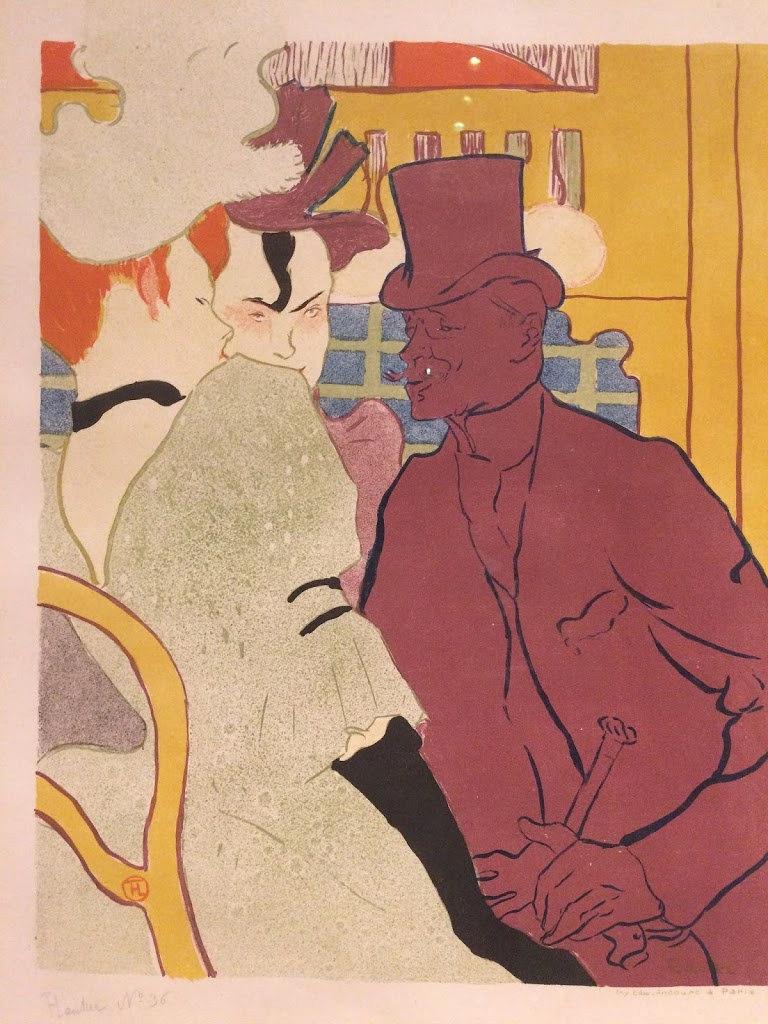
The Artisan Moderne. 1896, Lautrec was asked to advertise a jeweler/home goods designer
He manages to add some of his own thoughts and observations about human nature. |
This is the last weekend of Phillips Collection’s exhibition,Toulouse-Lautrec Illustrates the ‘Belle Epoque.’ The Phillips organized the show with the Montreal Museum of Fine Arts, its only other venue North America. This exhibition is different and distinguished from other exhibitions of Henri de Toulouse-Lautrec (and I’ve seen a few of them), because it’s primarily graphic art and contains some works that we don’t normally see. There are trial proofs alongside the finished prints, and a few very rare prints. The entire show comes from one private collector in France and we’re very lucky to have it for a short time in Washington.
 |
Mademoiselle Eglantine’s Troupe, 1895- 1896 Brush, spatter and crayon
lithograph in three colors. The dance troup included Jane Avril, seen below |
Toulouse-Lautrec’s color is magical but it’s really his sensational line that was his greatest gift. He follows a string of other great 19th century line artists: Ingres, Daumier, Degas and Hokusai, but he broke entirely new ground in the world of graphic art. In this exhibition, some of the familiar posters are shown in different stages, and it’s a great starting point to understand something of the lithographic process. Lautrec mastered the medium of color lithography, using multiple stones for the different colors of ink.
He’s best known for creating poster advertisement for entertainers and other highlights of Paris night life. Certainly he did a lot to bolster the careers of certain singers and performers such “La Goulue,” Jane Avril and Aristide Bruant. His posters were all over the kiosks of Paris and his work began a new trend. Although Lautrec was from an aristocratic background, he reveled in the demimonde and the bohemian lifestyle. He captured the people, places and events with so much vitality that the viewer almost wishes he or she could be there. The “Belle Epoque” is the beautiful era and in the USA it reflects the time of “The Gilded Age or “The Gay Nineties.”
 |
| Jane Avril, 1899 |
Depicting the subjects with wit and whimsy, and it’s clear that Lautrec’s art always captured much more than a photograph could. Sometimes his faces seem to be sneering at us. His expressive, calligraphic line is pure magic in how it captures a quick impression. He also masters the integration of letters into design, an essential for good graphic art. He portrayed Jane Avril several different times — in 1893, in t
he Divan Japonais, with
Mademoiselle Eglantine’s Troupe and again in 1899. The poster of Jane Avril from 1899 is particularly effective in design. Her undulating lines take up the entire picture from top to bottom, twisting to the right and then off the page on the left. It’s utterly simple, but effective design
Furthermore, it’s not only performers and night clubs that he enjoys. One of his friends, Sescau asked him to advertise his photography studio. He sets the fashionable lady in the foreground, running away from the photographer. With his sly humor, he makes suggests that photographer friend is looking at her in other ways, too. In a brilliant display of his design talent, the frills of this woman’s flowing cape match the rhythms of design in her fan, flowing in the opposite direction off the edge of the page.
 |
Photographer Sescau, 189 Brush, crayon and spatter lithograph, printed in five
colors. Key stone printed in blue; color stones in red, yellow and green |
Like other artists of his time — Van Gogh and Munch — he used jumps in space to heighten the meaning. It works well with the poster; the graphic artist’s challenge is to say a great deal with a minimal amount of detail and definition. In one of his most famous works, La Goulue at the Moulin Rouge, the master of ceremonies is at the picture plane. He’s merely a silhouette with pointed fingers, pointing to the artist’s signature put also to the celebrity whose dancing a can-can. Le Moulin Rouge was a 1890s version of “Dancing with the Stars.” Guests were able to mix and mingle with their favorite celebrities, and to dance alongside them.
 |
| La Goulue (Louise Weber) |
Of course the Moulin Rouge was also memorialized with a fictional character played by Nicole Kidman in Baz Luhrmann’s 2001 movie, Moulin Rouge. The story, but not the aesthetics in the move, fit with the time and place. John Leguizamo played Toulouse-Lautrec as an affable, good-natured character. Since childhood accidents and perhaps a genetic disease kept him from growing to normal adult height, he felt comfortable with other outsiders.
In actuality, La Goulue was Louise Weber, who had moved from the country (Alsace) into the city as a teen. She was approximately 24 at the time of her stardom as one of the most popular dancers in Paris. Her nickname, “the glutton” probably refers to how she took from others — food and drink.By the time she was 30, she was tired, wasted, impoverished and alcoholic. (In his prints, and paintings, she’s always recognized by her topknot. ) Unfortunately, there’s similar sad tales played out by some young stars today.
 |
La Goulue at the Moulin Rouge, Brush and Spatter lithograph, printed
on two sheets of wove paper. Final print
|
Many other famous posters are on view in full splendor, including images of Aristide Bruant and Marcelle Lender. This must-see exhibition is pure visual delight. It also offers a great deal of technical information about Lautrec’s astounding graphic techniques. This is just a small sampling of the many fantastic posters, paintings and graphics that are part of the exhibition.
Copyright Julie Schauer 2010-2016
by Julie Schauer | Apr 8, 2016 | 18th Century Art, Elizabeth Vigée-LeBrun, Metropolitan Museum of Art, Portraiture, Women Artists
 |
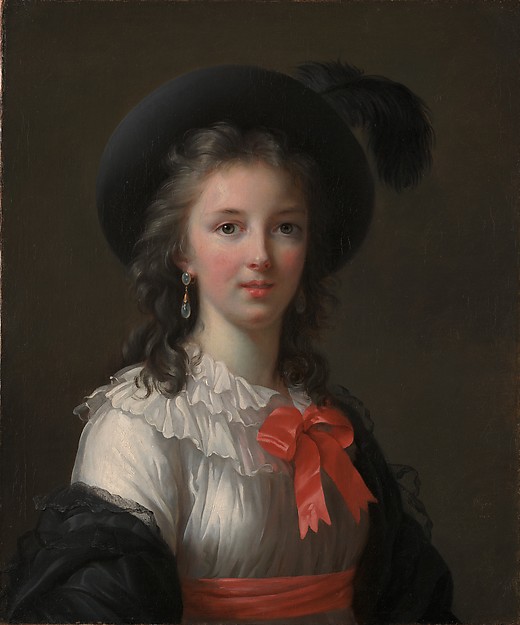
| Elisabeth Vigée-Le Brun, Self-Portrait with Cerise Ribbons, c. 1782, Kimbell Art Museum |
Vigée-Le Brun: Woman Artist of Revolutionary France is major exhibition at the Metropolitan Museum until May 15. Élisabeth Louise Vigée-Le Brun’s Self-Portrait from the Kimbell Art Museum explains her quite well. She shines with the confidence and elegance of a woman who would eventually become an international superstar. It shows off her top-notch artistic skills. Touches of brilliant red for the ribbon, sash, lips and cheeks to add sensual pizzaz. Portraits are not my favorite genre of painting, but Vigée-Le Brun’s portraits are always dazzling. The light radiating through her earring is just the right touch. One reason we never hear her mentioned among France’s top ten or twenty painters is that she was a painter of royalty who supported the wrong side of the French Revolution. It is only last year that France gave her a major retrospective, although her international reputation was strong back in her day.
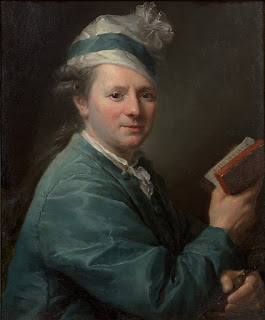 |
Jacques-Francois Le Sevre, c. 1774
Private Collection |
Vigée-Le Brun compares well with Jacques-Louis David and the very best French artists of her time. For the most part, she was fairly traditional rather than an innovator. Her style has elements of the late Rococo and Neoclassical styles, but with the addition of some naturalistic features. She was largely self taught, having learned from her painter father before he died when she was 12. Her mother was a hairdresser. She set up her own studio at age 15, supporting herself, mother and younger brother. After her mother remarried, she painted her stepfather, Monsieur Le Sevre (whom she really didn’t like, though I can’t discern it in the painting.) She was only about 19 at the time she painted it, around the same time she entered the Academy of Saint Luke, the painter’s guild.
Vigée-LeBrun was earning enough money from her portrait painting to support herself, her widowed mother, and her younger brother. T – See more at: http://www.nmwa.org/explore/artist-profiles/%C3%A9lisabeth-louise-vig%C3%A9e-lebrun#sthash.AhJDfSMB.dpufsupporting herself, her mother and younger brother. After her mother remarried, she painted her stepfather. The portrait of Monsieur LeSevre, is superb, though the artist was probably no older than 19. Around the same time, she joined the Academy of St. Luke (the painter’s guild). She soon made her way to the top. A few years later, she was called to work at Versailles, becoming the personal painter of Marie Antoinette. She commanded some very high prices for her work.
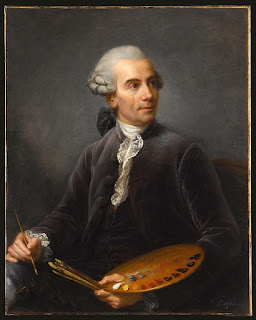 |
| Joseph Vernet, 1778, Louvre Museum, Paris |
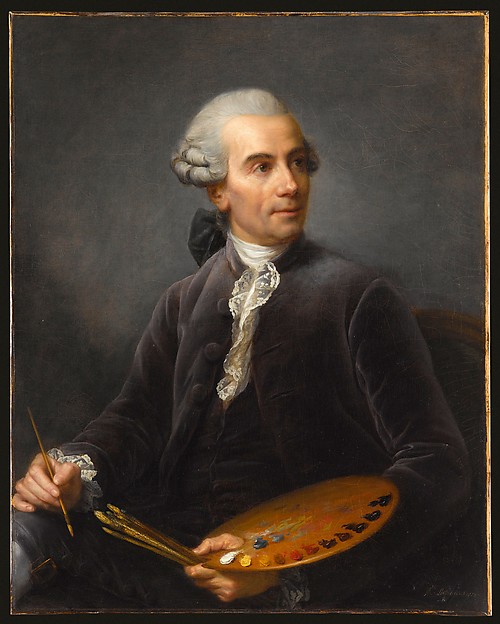
In 1778, she painted Joseph Vernet, a distinguished older painter of seascapes whom she greatly admired. He counseled her to always look at nature. I had seen the Vernet portrait in a NMWA exhibition a few years ago, a monumental exhibition that brought to light many of the gifted female artists of the era. the Met describes Vernet as her mentor, and it’s easy see the affectionate expression in this portrait. It has a wonderful harmony of various blacks and grays.
Painters are sometimes divided into those who are great draftsmen (like Michelangelo and Ingres) or great colorists (like Titian and Rubens). Vigée-Le Brun combines drawing ability and an exquisite sense of color. (There are several drawings in the exhibition.) Vigée-Le Brun’s father, Louis Vigée was a pastel artist and the self-portrait she did in pastel is just lovely. It combines loose, free lines with delicate, subtle modeling to make the face pop out. What other artists can make black, white and gray so interesting?
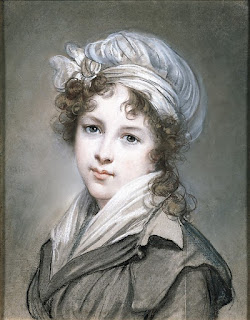 |
Self-portrait in Traveling Costume
1789-90, pastel, Private Collection |
Marriage, Her Husband and Daughter
In 1776, she married Jean-Baptiste-Pierre Le Brun, a painter, art dealer and a great connoisseur who fostered an appreciation of northern artists. He was the grandnephew of Charles Le Brun, founder of the French Academy. Together they traveled to Flanders and the Netherlands to study the northern artists. She was a greater painter than he was, but it was a connection of great mutual benefit for both of them. In 1780, a daughter, Jeanne Julie, was born. Julie became the subject of many of her mom’s paintings. A real gem of the show is the portrait of her daughter looking in a mirror. It simultaneously gives us a frontal and profile view. It is also a very sentimental painting.
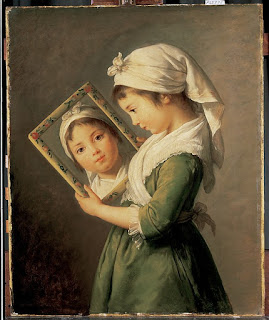 |
Julie LeBrun Looking in a Mirror
c. 1786, Private Collection |
One self-portrait by her husband is in the exhibition. He was probably the most important art connoisseur and dealer in France in his time. Pierre Le Brun is credited with writing the most important book on Netherlandish art and elevating the reputation of one of the world’s most popular Old Masters, Johannes Vermeer.
In 1783, Vigee-Le Brun gained entry into the prestigious Royal Academy, one of only four women in the elite group. There was some conflict of interest, because her husband’s profession as an art dealer could have disqualified her. However, King Louis XVI used his influence to promote her. Even at the relatively young age of 28, she commanded higher prices than her peers.
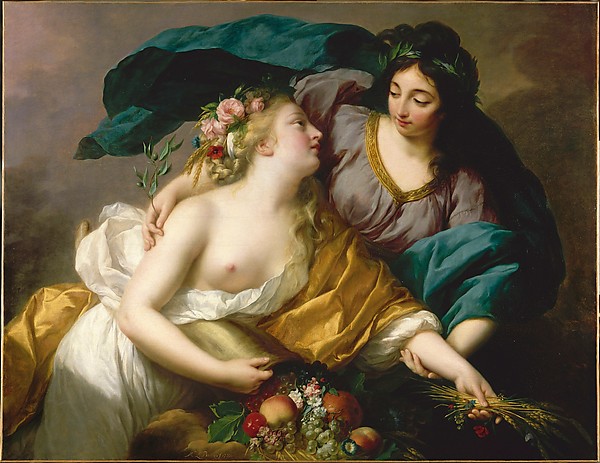
At the time, history painting, meant to instruct and moralize, was considered the highest category of painting. The canvas she submitted for admission into the French Academy was an allegorical piece meant to inspire virtue, Peace Bringing Back Abundance. As the name suggests, prosperity comes from staying out of war. While the classical Grecian style of this painting is not the taste of today, it’s her colors that I love. Unfortunately, peace would not remain in her life and in France for very long.
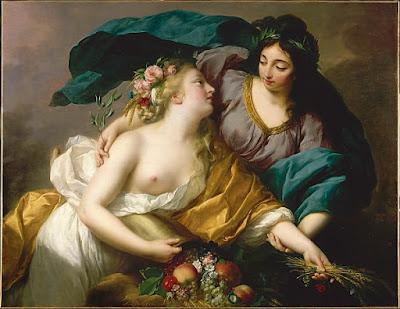 |
| Peace Bringing Back Abundance, 1780, Louvre Museum, Paris |
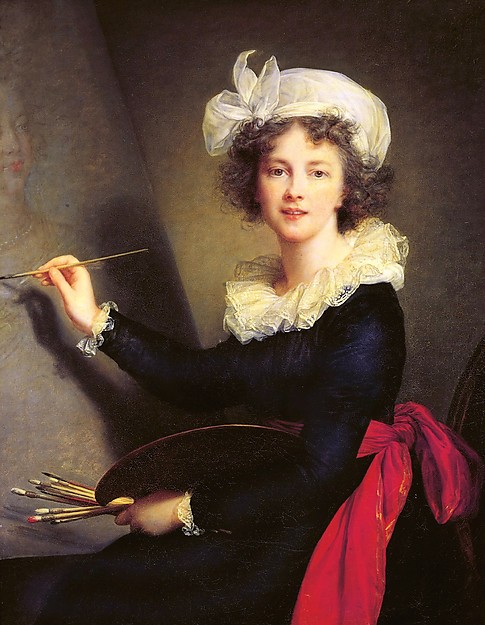
When Marie-Antoinette fell from favor and lost her life, Vigée-Le Brun had reason to be afraid. She left France for Italy, with her daughter and without her husband. She was quickly accepted into the Accademia di San Lucca in Florence. She was asked to add her portrait to the the Corridoio Vasariano at the the Uffizi, an obvious sign that her reputation preceded her. This self-portrait in the Uffizi Gallery, painted in 1790, is one of her most famous paintings (below). According to the Metropolitan Museum, the ruffled collar was meant to show her affinity to Rubens and Van Dyke. The cap is reminiscent of self-portraits by Rembrandt, but the brilliant red sash and the use of color contrast is strictly Elisabeth Vigee – Le Brun. It shows greater spontaneity than some of her royal commissions. A few years earlier she had been criticized for breaking with convention by painting self-portraits with an open mouth, making them look less serious.
 |
| Self-portrait, 1790, Uffizzi Gallery, Florence |
With her out of the country and the Reign of Terror going on in France, her husband was forced to divorce her. (When the aristocracy lost power, he also lost his major clients.) She remained in exile for 12 years, but painted in the Austrian Empire, Russia and Germany. Her services as a painter were in high demand and she commanded high prices from her lofty, aristocratic clients. In particular, she painted many Russian aristocrats, including one owned by the National Museum for Women in the Arts which is not in the current exhibition.
Portraits of Russian and Foreign Aristocrats
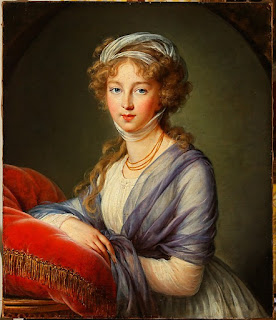 |
Duchess Elizabeth Alexyevna, 1797
Hessische Hausstiftung, Kronberg |
Many of the paintings on view at the Met are from private collections, suggesting that many portraits may still be owned by descendants. None of her paintings from Russian museums are on loan to the United States, because of diplomatic problems at this time. The exhibition going to National Gallery of Canada in June will have several paintings from the Hermitage that are not in the New York show. These paintings were included in the Paris, where the exhibition started.
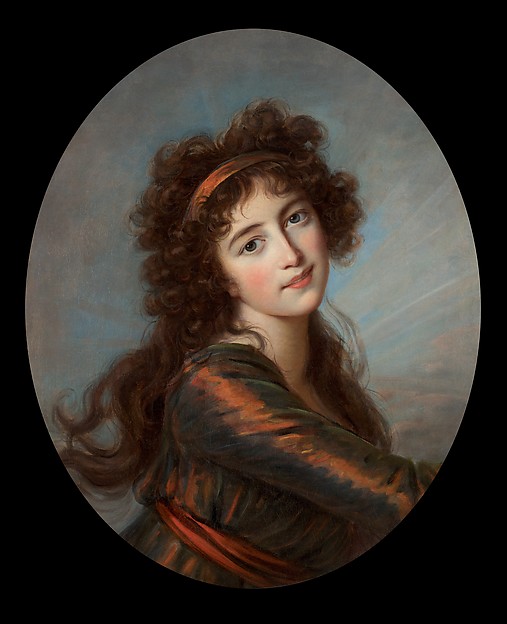
Vigée Le Brun painted at least five portraits of Grand Duchess Elizabeth Alexyevna, but the example here has a sumptuous red cushion and a transparent purple shawl, that sets off nicely against white skin, dress and long flowing hair.
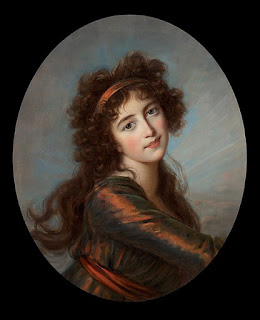 |
Duchess von und zu Liechtenstein as Iris
1793, Private Collection |
Vigée Le Brun also enjoyed depicting personifications and allegory, as did many of the artists of this era. At one time she painted her daughter as the goddess of flowers, Flora. When she painted the beautiful Duchess von und zu Liechtenstein, she imagined her as Iris, the goddess of the rainbow. The colors shine brightly, though a rainbow which I expected to discern in real life, at the exhibition can’t be found in the painting.
In general, she greatly flattered her sisters. It would seem that she only painted women who were beautiful. At the Metropolitan show, about 5/6 of the paintings portray female sitters. She carefully considered all props, and how to reflect the personality of the sitter. Vigée Le Brun figured out how to bring out their best features and reflect the personality of the sitter.
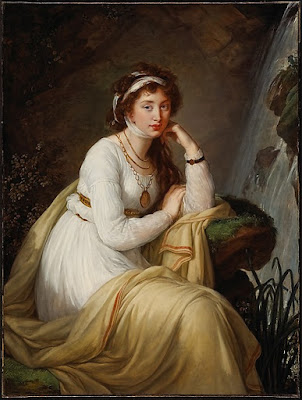 |
| Countess Anna Ivanova Tolstaya, 1796, National Gallery of Canada, Ottawa |
The use of materials, props and settings is crucial to her goals. A portrait of Countess Anna Ivanova Tolstaya has a large outdoor background taken from the natural world, a Romantic setting. The countess looks dreamy and wistful. In general, there is a very wide variety to the types of colors she used, and the harmonies she created. The National Museum of Women in the Arts currently has an exhibition on Salon Style, which includes portraits by Vigee Le Brun, among other French women artists. An unattributed pastel of Marie Antoinette would appear to be by Vigee-Le Brun, too, or at least copied from a painting by her.
Vigée-Le Brun’s Legacy and Queen Marie-Antoinette
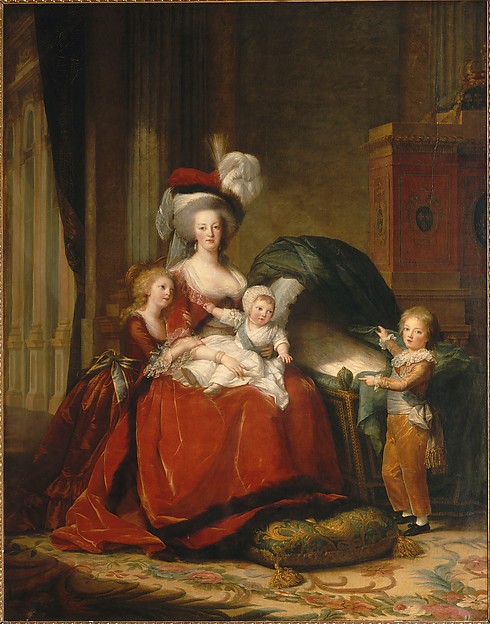
From a strictly historical perspective, however, her connections to the French Royal family may be the most important contribution. From her many portraits of Marie-Antoinette, historians can look for clues into the life and character of this demonized queen. It’s difficult to figure out if Marie-Antoinette was really as bad a person as history portrays her. I saw the Kirsten Dunst movie about her and more recently a play about her, both of which show her as a tragic figure who was a foreigner and really didn’t really know how to fit into the world into which she married. We may never really know. Marie-Antoinette may have wanted Vigée Le Brun to soften her image. Several portraits of her are in the exhibition. The bouffant, powdered hairdos don’t beautify her to me. Marie-Antoinette and Her Children, a large, flamboyant group portrait loaned shows the young queen with three children and an empty cradle. It emphasizes that the Austrian-born queen had recently lost a child. So even in this sumptuous setting there is great sadness and loss.
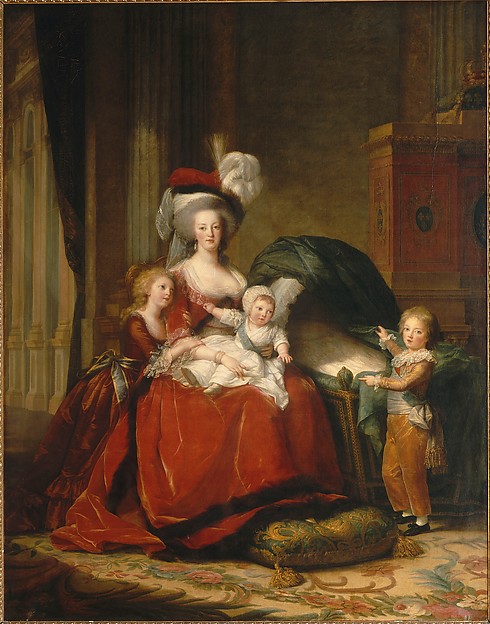 |
Marie-Antoinette and Her Children, 1787, Musée National des
Chateaux de Versailles et de Trianon |
Madame Royale and the Dauphin Seated is a portrait of the two oldest children when the were around 3 and 6 years old. The princess’ satin dress is brilliant display of Vigee Le Brun’s skill at portraying texture. The pastoral background is nostalgic and adds to the sense of innocence. It gives no hint of what’s to come. The prince died of tuberculosis in 1789, ate age 7. (Dauphin County, Pennsylvania is named after him.) Marie-Therese, named for her grandmother, was imprisoned between 1789 until 1795. She was queen 20 days in 1830 and lived until 1851, but generally had a very sad life. There is actually one landscape painting in the exhibition (and there were several landscape drawings in the Paris exhibition), but Vigee Le Brun is first and foremost a portrait painter.
 |
Madame Royale and the Dauphine Seated, 1784, Musee National
des Chateaux de Versailles et de Trianon |
|
Between 1835 and 1837, Vigée Le Brun wrote her memoirs. A remarkably great artist and a remarkable woman, she lived to be 86. She is appreciated much more than for her paintings of many Marie – Antoinette. When I took a college Art History class that started with the French Revolution and went to about 1850, we didn’t cover Vigée-Le Brun. David, the academic teacher who influenced so many students, was treated like a god in my class. I find it curious that Vigée-Le Brun remained completely loyal to the royal family, while David was such a politician. He painted for the king, turned into a revolutionary and then easily switched gears to become Napoleon’s artist. He secured his reputation for posterity. With this exhibition traveling to Paris, New York and Ottawa, Vigée-Le Brun’s reputations will go up a few notches, putting her in a rank equal rank to that of David. The Metropolitan has a complete list of paintings in the exhibition. See the Met’s video of her.
Copyright Julie Schauer 2010-2016


 To be honest, valuing art primarily for its monetary or investment value really offends me. I briefly worked in the 80s at the art gallery considered one of Chicago’s leading contemporary galleries at the time. It was surprising to go from a show of DeKooning’s latest works (painted with mayonnaise) to one of photographs of Racquel Welch (by an important photographer). Although these exhibitions generated a ton of publicity, they actually sold very little — just one DeKooning and none of the Racquel Welch photographs. (sh….that was an art world secret.)












Recent Comments